Bassel Al-Sayed: Gulf Investments and Investment Applications Are on the Rise
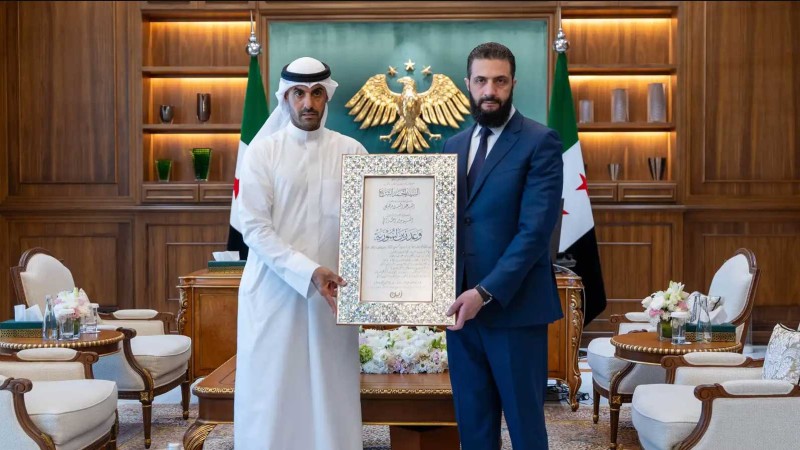
Syrian President Ahmed Al-Sharaa and Bader Al-Kharafi, Vice Chairman and Group CEO of Zain Group
The decision to grant Kuwait's Zain Group a 25-year license to operate a new telecommunications network in Syria, with investments estimated at approximately US$747 million, may be more than just an expansion in the telecommunications sector. It could represent the first real test of major Gulf investments entering the Syrian economy after years of war and economic isolation.
The deal is considered one of the largest foreign direct investments (FDI) in Syria in recent years. It also comes within a broader context indicating growing interest from Gulf investors in the Syrian market, amid signs that the Syrian economy is beginning to transition from reliance on aid and the informal economy toward long-term productive investment.
Firas Shaabo, Professor of Financial Management at Başakşehir University, believes that the entry of an investor the size of Zain reflects "a gradual improvement in the assessment of investment risks in Syria." He explained that investors do not wait for all risks to disappear; rather, they evaluate the balance between risk and expected return.
Shaabo stated that the entry of a regional company of this scale indicates that Syria's investment environment has become more capable of managing risks compared to previous years, although it remains far from achieving full stability.
He added that Syria is still in a "market testing" phase, with companies entering gradually. He noted that any additional developments—such as the removal of Syria from the list of state sponsors of terrorism—would provide a significant boost to foreign investment.
Why the Telecommunications Sector?
Shaabo points out that telecommunications is among the world's most attractive investment sectors after natural resources, due to its ability to generate stable revenues and recover capital relatively quickly.
He explained that the sector's unique advantage lies in its limited exposure to external commercial fluctuations and its stable demand base, making it one of the lowest-risk investment sectors, particularly in economies undergoing reconstruction.
Furthermore, developing the telecommunications sector extends beyond traditional services. It serves as the foundation for digital transformation, e-government, digital financial services, and artificial intelligence (AI) applications, giving it strategic importance that goes beyond direct investment returns.
Zain Is Not the First Gulf Investment
For his part, Bassel Al-Sayed, CEO of Effect Plus, the organizer of IMAR Syria and BIG 5 Construct Syria, emphasized that the Zain deal is an important indicator but not the beginning of Gulf interest in the Syrian market.
Al-Sayed stated that both Gulf investments and investment applications have increased significantly over recent months, with interest shifting from small and medium-sized projects to large-scale investments across the real estate, agriculture, tourism, energy, and infrastructure sectors.
He added that Gulf investors—particularly from Saudi Arabia, the United Arab Emirates, Kuwait, and Qatar—currently represent the largest group of investors interested in Syria, noting that the majority of memoranda of understanding (MoUs) and investment applications submitted to the Syrian Investment Authority originate from Gulf companies.
He further revealed that Gulf companies have already begun implementing real estate, tourism, and investment projects worth hundreds of millions of dollars, considering Zain's entry as another indication that Syria has entered a new phase of major investments.
Trade Exhibitions Becoming Investment Indicators
Al-Sayed believes that economic exhibitions have become Syria's primary "gateway to investment," thanks to their ability to bring together investors, decision-makers, and government entities in one place.
He noted that the results of IMAR Syria reflect this trend. Surveys conducted after the 2025 edition showed that approximately 82% of participating companies either secured direct investment benefits or entered negotiations, signed memoranda of understanding, or launched new projects.
He added that participation in the 2026 edition of IMAR Syria has more than doubled compared to the previous edition, reflecting growing interest from regional and international companies in the Syrian market.
Which Sectors Are Expected to Benefit?
According to Shaabo, telecommunications may only be the beginning. Syria offers substantial investment opportunities in the energy, oil and gas, renewable energy, infrastructure, transportation, ports, real estate, financial services, and banking sectors.
He explained that developing the financial sector represents both one of the country's greatest challenges and one of its greatest opportunities, given the need to modernize payment systems and banking services while strengthening confidence in financial institutions to attract investment and support reconstruction efforts.
He added that the entry of major international and Gulf companies provides not only financing but also managerial and technical expertise, improves the quality of services and infrastructure, and contributes to higher economic growth and employment.
What Does Syria Need to Attract More Investment?
Despite these positive indicators, Shaabo stressed that transforming Syria into an investment-driven economy requires gradual reforms, including strengthening political and economic stability, improving the legal and institutional framework, reforming the financial and banking sectors, and ensuring the protection of private property rights.
Bassel Al-Sayed, in turn, believes that the greatest challenge remains the modernization of investment laws and regulations, safeguarding investors' rights, facilitating profit repatriation, and reintegrating Syria's financial system into the global economy.
He noted that regional and international financial institutions have already begun conducting exploratory assessments of the Syrian market. However, they are still awaiting the completion of financial and banking reforms, foremost among them the full restoration of international money transfer services.
Leave a Comment